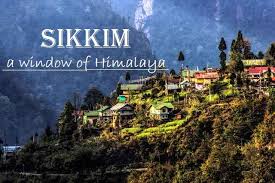
Tucked away in the lap of the Himalayas, Sikkim is a nature lover’s paradise as it is filled with lush forests, pristine lakes, gurgling rivers, thick rhododendrons, hot sulphur springs, vast meadows and picturesque valleys.
The winter in Sikkim is extremely cold with never ending snowfalls. Winter temperature in the region averages between 4 °C (39 °F) and 7 °C (45 °F). But it looks mesmerising with snowcapped mountains, rivers and roads.
Paradise of nature
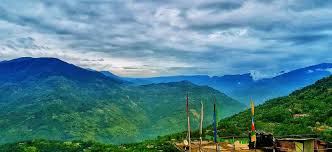
Sikkim is a Paradise on Earth: It’s sheer Magic.Its Natural Beauty is just unbelievable.It is a Land of Rugged Mountains, Deep Valleys, Dense Forests , Rivers , Lakes , waterfalls, Monasteries and Pagoda – style Houses.It is situated at an Altitude of 5800 ft.( 1,547 metres) between the borders of Nepal, Bhutan and Tibet . It’s a Pollution – free Organic State that lies in the Lap of Mt.Khangchendzonga, 3rd highest mountain in the world .The place is easily approachable by Airways , Railways, Roadways & Helicopter.Gangtok,the State Capital presents a picturesque and serene repose in the lap of Nature.Here you will find a blend of Lepcha ,Bhutia and Nepali Culture and Cuisine.The place has attractions for people of every age, faith, culture and interest.For Adventure- lovers there is Ropeway, Helicopter -ride,Paragliding,River Rafting, For Elderly there are Temples like Hanuman Tok,Ganesh Tok and Monasteries like Rangka,Rhumtek etc.The experience to visit Nathu La was really wonderful.The snow-capped on the way as well as the panoramic view at Tsomgo Lake and Baba mandir Present a real Feast to Eyes .Its beauty is mesmerizing.We had never seen so much of snow in our life earlier. Besides Gangtok there are several other place like Lachen, Lachung, Rinchenpong, Solopok, Thangu,Varsey,Yuksom, Yumthang, Yumesamdong in Sikkim.Plan a trip to this place only once and I’m sure you will always rewind your memoriesPosted inUncategorized
Sikkim is a beautiful land of manifold tribes and races of people living together. All these diverse tribes and communities have their unique features in addition to their particular dance forms, festivals, languages, culture, and craft forms. The miscellany of ethnic groups, religion, and languages is seen all over Sikkim. of Sikkim before planning your trips.
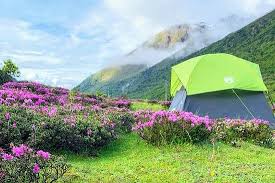
Whether of sikkim
The winter in Sikkim is extremely cold with never ending snowfalls. Winter temperature in the region averages between 4 °C (39 °F) and 7 °C (45 °F). But it looks mesmerising with snowcapped mountains, rivers and roads.Sikkim’s climate ranges from sub-tropical in the south to tundra in the north. Most of the inhabited regions of Sikkim experience a temperate climate, with temperatures seldom exceeding 28 °C (82 °F) in summer. The average annual temperature for most of Sikkim is around 18 °C (64 °F).
Sikkim Cuisine
For food lovers, Sikkim is famous for traditional Himalayan cuisine. Rice is the principal food of Sikkim. … Dumpling (Momos) is on the top of the list of famous cuisine of Sikkim. Other mouth-watering cuisines of Sikkim include Thukpa, Phagshapa (Gya Thuk), Dhindo, Dal Bhat, Sha Phaley, Gundruk, Sinki, etc.Sikkimese cuisine is full of flavours and is based on rice and maize mainly. It is one of the reasons that most of the dishes made is Sikkimese cuisine have rice and maize in some form or the other. Here are some of the most popular dishes apart from Thukpa and Momos, that are surely worth a try.
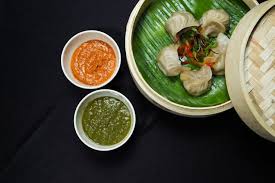
Sikkim is one destination in the North East that’s not just famous for its scenic beauty but the amazing local food influenced by neighbouring countries like Tibet, Nepal and Bhutan. Sikkimese cuisine is full of flavours and is based on rice and maize mainly. It is one of the reasons that most of the dishes made is Sikkimese cuisine have rice and maize in some form or the other. Here are some of the most popular dishes apart from Thukpa and Momos, that are surely worth a try.

Traditional Dresses of Sikkim – Bakhu and Other Sikkim Dresses
1. Bhutia Tribe – Bakhu/Kho
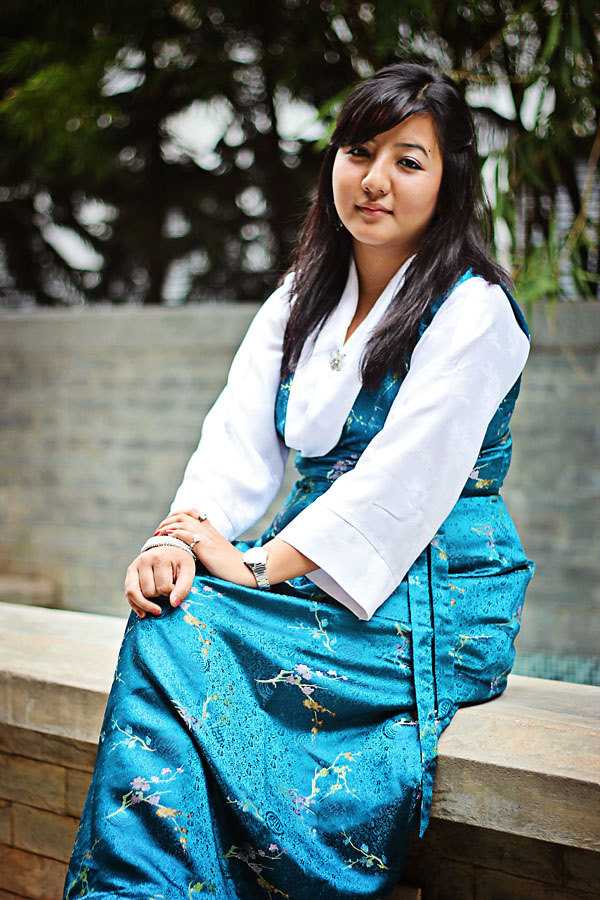
The main costume donned by Bhutias is the Bakhu (according to the Nepalese dialect) or Kho (according to the Bhutia dialect). Worn by men and women alike, Bakhu is very similar to the Tibetan Chuba, except that it is sleeveless. It is a loose cloak-like garb which is tied at the neck and tightened around the waist by a belt made of silk or cotton. The Bakhu has found modifications over the years. Women nowadays pair it with a pair of jeans to add a western twist to the look. Shawls popularly known as Majetro and classy blouse designs like Chaubandi Cholo and Tharo Cholo are also in fashion.
2. Thokro-Dum
sikkim dresses, dresses of sikkim
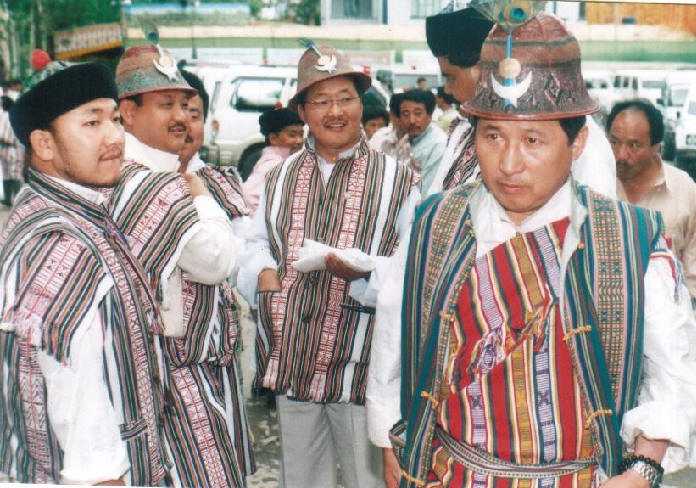
The traditional Thokro-Dum of Lepcha community (Source)
The Thokro-Dum is the primary outfit for the Lepcha community members. Usually, the Lepcha bread makers sport this. It consists of a white pyjama stretching up to the calves, almost resembling a karate player’s outfit. Yenthatse, a Lepcha shirt and Shambo, an embroidered cap are paired with it. A multicoloured, hand-woven cloth called the Dumpra is pinned at one shoulder and held in place by a waistband. The short length of the pyjama indicates that the men have originated from or lived long in marshy land. The texture of the material is rough and long-lasting, suitable for a hard day of toiling in the field. Many times, traditional cone-shaped bamboo and rattan hats are also worn.
3. Dumvum
sikkim dresses, dresses of sikkim
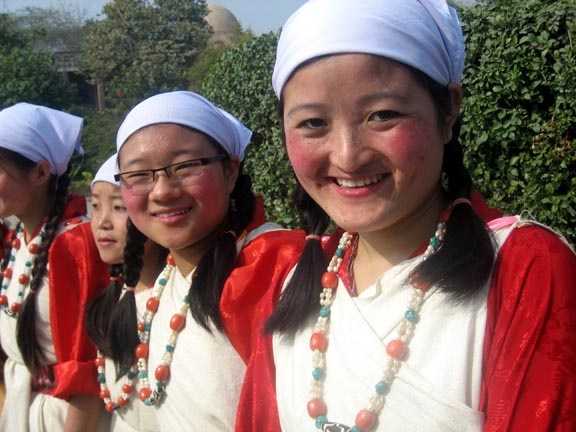
Lepcha women in the traditional Dumvum (Source)
The traditional attire of Lepcha women involves a sari-like garment known as Dumvum or Dumyam. It is an ankle-length outfit, silky and smooth binding comfort and culture together. Underneath, a loose-fitting blouse in a contrasting colour is worn known as Tago. To complete the look, a type of belt called the Nyamrek and Taro, a cap is worn. A scarf called Gorey is often used to cover the head.
There is an interesting distinction between the costumes of Lepcha men and women. While the calf-length bottom of the Thokro-Dum indicates their life in a marshy land, the flowy Dumvum suggests that they are dry-land inhabitants. While the male costume is coarse, made for the rugged nature of their labour in the fields and forests, the female costume is a lighter, softer material rendering the outfit graceful and feminine.
 Sikkim-The nature of love